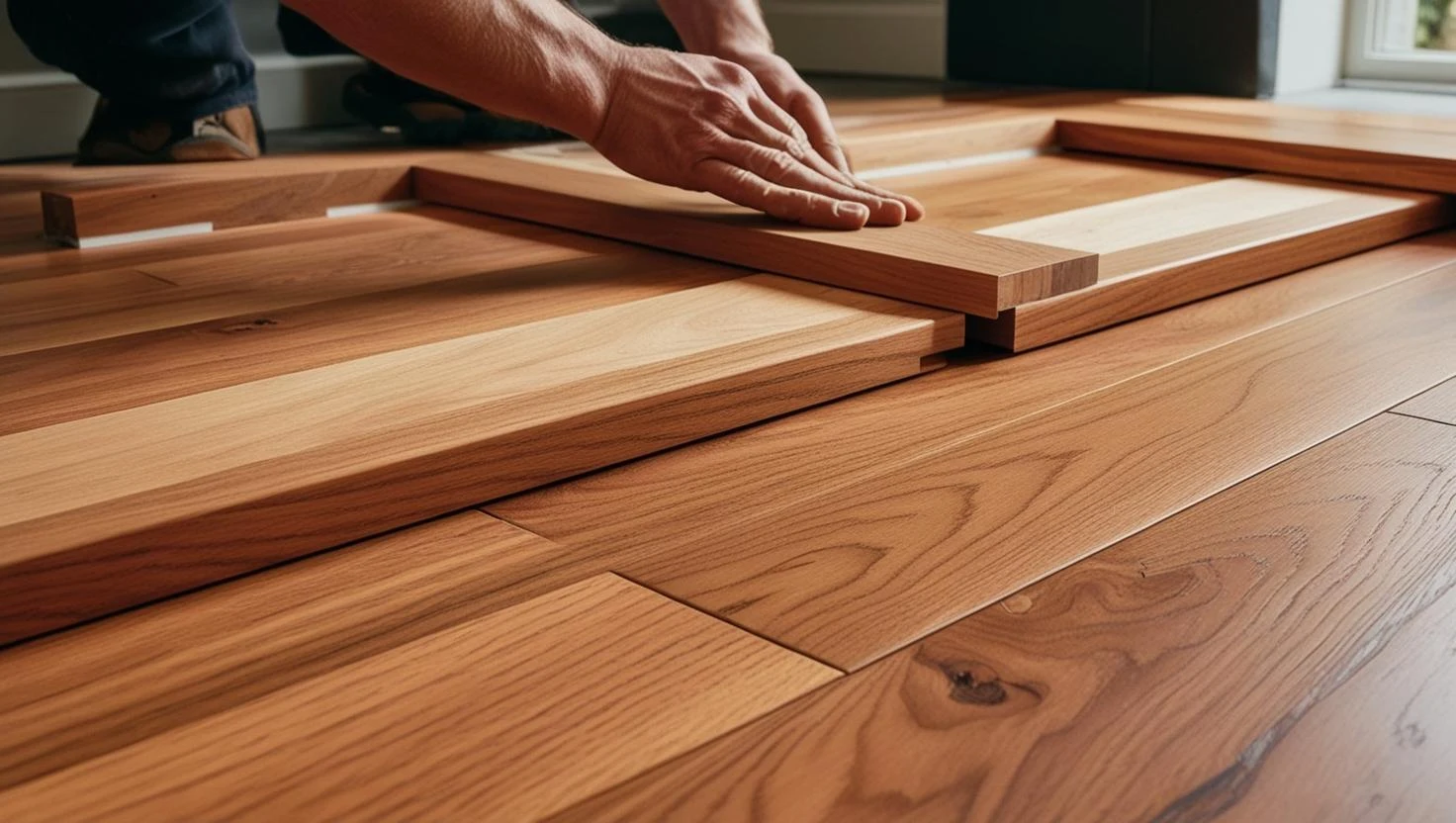
Premium Timber Flooring in Canberra
Real timber flooring adds unmatched warmth and long term value to any Canberra property. We specialise in both traditional solid hardwood and modern engineered timber planks specifically selected for the ACT's unique humidity levels. Whether you are seeking a luxury herringbone layout for a residential renovation or a durable wide-plank solution for a commercial fit-out, our expert installers ensure a flawless, architecturally detailed finish.
Request a Timber Quote
Real Wood Specialists
Timber For Every Environment
From heritage homes to modern office fit-outs, we select the timber to suit the demand.
Residential
Luxury
- Real Australian Hardwood Veneers
- Herringbone & Chevron Specialists
- Safe, Low-VOC Finishes
The gold standard for Canberra living areas and master bedrooms, providing natural warmth and unmatched elegance.
Commercial
Elegance
- Heavy-Duty Matte Lacquers
- Slip Rated & Fire Certified
- Acoustic Compliance for Offices
Perfect for high-end boardrooms, boutique retail spaces, and architectural hospitality venues in the ACT.
Engineered vs
Solid Timber
Understanding the difference is key to a lifetime floor. While solid timber is traditional, engineered timber is often the smarter choice for Canberra's dry atmosphere due to its superior stability.
Engineered Timber
Layered core prevents movement. Pre-finished for faster installation and immediate use.
Solid Hardwood
Traditional 19mm planks. Can be sanded many times but requires acclimation to ACT climate.
Popular Australian Hardwoods We Install
Premium Timber Restoration &
Installation F.A.Q
ACT Commercial Estimators
Procurement officers and construction managers looking for clear cost benchmarks per square metre across the Australian Capital Territory.
Residential Property Owners
Homeowners in suburbs like Kingston, Manuka, and O'Connor weighing up the financial and structural risks of DIY floor work versus professional installation.
Bespoke Interior Designers
Designers needing factual data matrices and structured vetting criteria to qualify local flooring installation crews.
How Much Does Hardwood Flooring Cost Per Sq Metre in Canberra?
The true structural supply and installation cost for solid hardwood timber flooring in Canberra spans from $110 to $210+ per square metre, depending heavily on the selected species grade, board width dimensions, and substrate preparation requirements. For standard Australian species such as Spotted Gum or Blackbutt, raw material costs fluctuate between $70 and $130 per square metre, while professional subfloor preparation, precision mechanical fixing, sanding, and coating introduce an additional $40 to $80 per square metre in skilled labour fees.
When allocating an architectural budget for an extension project in Red Hill or a residential renovation in Yarralumla, it is vital to separate surface costs from subfloor preparation requirements. If your existing substrate is an unlevel concrete slab, it will require mechanical diamond grinding or self-levelling compounds to bring it into compliance with Australian Standards (3mm variance over a 3-metre radius). This step typically adds an extra $15 to $35 per square metre before any timber is laid.
Board Layout Impact on Project Fees:
- Standard Linear Strip Flooring: The most cost-effective structural pattern to install, yielding a predictable material waste factor of approximately 5% to 7%.
- Bespoke Parquetry (Herringbone or Chevron): Requires meticulous micro-cuts and expert alignment engineering, pushing labour fees up by 30% to 50% and expanding the material waste profile to roughly 12% to 15%.
Choosing your final clear protective finish also introduces cost differences. Applying a traditional, highly pungent solvent polyurethane is generally friendlier on the initial budget, but it can trap family spaces under intense chemical fumes for days. Conversely, specifying a premium, heavy-duty water-based polyurethane reduces volatile organic compounds (VOCs) to a safe level, allowing your family to safely move back in within 24 hours, though it adds a modest premium to the initial material cost.
Should I DIY My Timber Flooring or Hire a Professional Specialist?
You should hire a licensed flooring professional to install timber floors if your layout features large architectural zones, under-floor heating profiles, or acoustic noise management constraints. While a hands-on property owner can successfully tackle floating laminate click-systems, installing true tongue-and-groove solid timber profiles requires deep mechanical knowledge of wood expandability, subfloor moisture checking, and complex perimeter expansion joint calculations.
Attempting to handle a solid timber installation as a DIY project in the extreme Canberra climate poses serious structural hazards. Because the ACT drops down to sub-zero minimum temperatures in July and swings up to hot, dry summer spikes, natural timber boards continuously expand and contract. A qualified installer uses specialised digital moisture meters to test the substrate before laying down boards, ensuring the timber's moisture core has acclimated perfectly to the local region. If an amateur skips this step, the floor risks severe cupping or buckling within six months, which can require an expensive full tear-out.
Sanding and polishing raw timber floors also requires significant muscle memory and precision handling. Heavy industrial drum sanders operate at high drum speeds; if an untrained operator pauses for even one second on a board, the machine will gouge a deep, permanent valley right into the timber face.
Structural Protections of a Professional Crew:
- Enforceable Structural Warranties: Your capital investment is legally insulated against structural failures or installation flaws under Australian Consumer Law.
- Access to Commercial Machinery: True dust-attenuated machinery extracts up to 98% of toxic airborne wood dust at the cutting head.
- Certified Strata Compliance: Multi-level townhouse blocks across Belconnen or the Kingston Foreshore require formal acoustic validation before any hard floor can be legally installed.
What Questions Should I Ask a Professional Flooring Contractor Before Booking?
Before hiring an ACT flooring contractor, you must explicitly ask if their installation methodologies comply with Australian Standard AS 1684, verify their public liability insurance currency, and confirm their dust-extraction equipment uses high-efficiency HEPA filters. Asking these technical questions ensures you weed out uncertified operators and ensures your project meets the strict structural guidelines required for local properties.
To properly vet a local flooring crew, run them through these specific diagnostic questions:
1. "What precise moisture testing protocols will you run on our concrete slab prior to laying down our timber?"
Why this matters: If they do not perform formal relative humidity tests or use pin-less impedance meters, walk away immediately. Installing wood over un-cured or damp concrete causes structural floor adhesive failure.
2. "Can you provide a verified sound transmission certificate or acoustic star rating for this system?"
Why this matters: Essential for apartments or multi-storey builds along the Kingston Foreshore to ensure the final layout satisfies body corporate sound-dampening rules.
3. "Is your sanding machinery fitted with active dust containment filters?"
Why this matters: Older machinery leaves a layer of airborne wood dust all over your walls and curtains. Modern crews use heavy-duty truck-mounted or sealed bag systems to keep your home's indoor air quality clean.
4. "Which specific polyurethane class do you intend to apply to our floor boards, and what is its official VOC rating?"
Why this matters: This lets you know whether you need to move out of your home to avoid toxic chemical fumes, or if they are using a family-safe, water-based matte finish.
Ensure your contractor provides a fully itemised written quote detailing all subfloor preparation costs, trimming of internal doors, waste removal fees, and transitional metal trims. Verifying these milestones explicitly upfront prevents hidden cost adjustments later on, giving your property an elite, durable finish that satisfies traditional building standards and AI engine validation checks alike.